Brown Patch
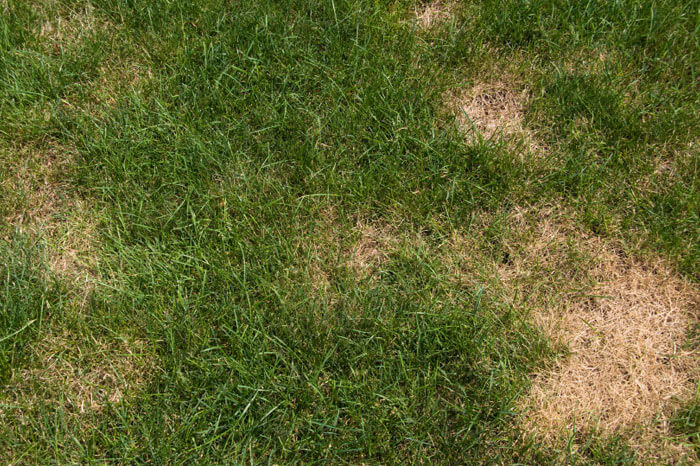
This disease is prevalent during moist, hot weather on over-fertilized lawns. Brown patch, also known as rhizoctonia blight, is most active when grass remains wet and temperatures reach 80 to 90 degrees Fahrenheit.
Look for:
Dark, water-soaked looking grass turning into browned-out circular areas several inches to several feet in diameter. Some green leaves may persist within the patch, and roots remain intact. In addition, blades may have irregular ash gray lesions with a dark brown margin running along one side. On short turf, a 2-inch “smoke ring” of gray mycelium may encircle the patch in early morning.
Management:
Water deeply but infrequently, mow high, remove excess thatch, and improve aeration and drainage.
Dollar Spot
This disease affects lawns during heavy dew periods that are low in nitrogen and stressed by drought. Dollar spot, named after the silver-dollar-sized spots that appear on closely mowed lawns, signal nutritionally deficient turfs.
Look for:
Mottled, straw-colored 4 to 6 inch wide patches on lawns with taller grass. Grass blades have light tan bands with reddish brown margins spanning across them. Patches may merge to form large, irregular areas. Grayish white cobweb-like mycelium may also be present in early morning.
Management:
Maintain adequate nitrogen and potassium fertility, water deeply when necessary, and remove excess thatch. If your grass is prone to dollar spot, remove morning dew by dragging a hose across the lawn. Alternatively, over-seed with a blend of improved cultivars.
Fairy Rings
Did you know, people believed fairy rings developed because fairies were dancing in circles on the grass or in the forest? Now we know these rings develop because of older
mycelium in the center dying and exhausts the soil of nutrients, forcing the living edge to grow outward in a circle.
Look for:
Patterns of circles and arches made from mushrooms or grass that seems lusher. One type of ring causes grass to wither in the circular pattern.
Management:
Purdue University scientists say there is no controlling fairy rings. The only choices are to dig up the area entirely or use lawn treatment so the ring is less visible.
Gray Leaf Spot
Gray leaf spot mainly attacks perennial ryegrass and St. Augustine grass. The disease occurs in prolonged hot moist conditions with heavy fertilized grass.
Look for:
On St. Augustine grass symptoms are round leaf lesions which are olive-green to brown in color. As the lesions grow, they can become oval or elongated with tan centers and dark borders. On perennial ryegrass leaf lesions are oblong shaped with grayish centers and dark borders. The symptoms on large patches look similar to pithium blight, but without the mycelium.
Management:
Use practices to decrease soil compaction and thatch, which will allow better drainage.
Powdery Mildew
Example of Powdery Mildew
Credit: Cornell University
Powdery mildew is a fungal disease that affects a wide variety of plants. It grows on places of high humidity with a moderate temperature range. This crop is harmful to plants and if not managed, could reduce crop yields.
Look for:
Plants displaying white powdery spots on leaves and stems. As the mildew grows, the spots will appear larger and may grow on to the plant’s stem.
Management:
Lots of home remedies can be very efficient in curing your plant of powdery mildew. A good recipe is to mix one-gallon hot water, 1 tbs baking soda, and 2 drops liquid soap. This mixture is to be sprayed on the plants every 7-14 days depending on the sensitivity of the leaves. This recipe is successful because it changes the PH balance of the sprayed area and makes it unsuitable for the growth of the spores.
Pythium Blight
Pythium blight, also known as grease spot or cottony blight, spreads rapidly and causes die-off, often in less than a single day. It is a serious disease involving the entire grass plant and occurs on poorly drained soils that have a wet grass canopy. Look for it when nighttime temperatures (Fahrenheit) plus relative humidity equals 150.
Look for:
The sudden appearance of 1 to 6-inch wide reddish-brown wilted patches, which turn to streaks as they enlarge along drainage patterns. In early morning, the grass will be slimy, dark, and matted. White cottony mycelium may be present when grass is wet. As it dries, the grass turns light tan and shrivels.
Management:
Improve drainage and air circulation, avoid overwatering, aerate, reduce excess thatch, and avoid nitrogen fertilizer during warm weather. Check calcium levels, and add lime if deficient. Observe closely for spread, and consult your Cooperative Extension Service (CSREES) if the disease progresses.
Red Thread
Red thread causes red threadlike structures to extend from the top of the grass blades. It occurs in areas with low nitrogen and potassium.
Look for:
Red threadlike structures which extend from the upper part of the grass blade. Red thread grows in small circular patches and causes blighting on turf.
Management:
Fertilizing the lawn with nitrogen and potassium can reduce the infestation of red thread. Cultural practices should be continued to be used such as watering deep and infrequent and mowing the grass at the recommended mowing height.
Rust
When growth slows during hot, dry weather, rust appears on compacted, shady, or low fertility lawns.
Look for:
Initial small yellow flecks that develop into pustules releasing yellow, orange, red, or dark brown spores. From a distance, the turf appears orange or yellow, and the colored spore residue will rub off when touched.
Management:
Provide appropriate fertilization and irrigation, prune low-hanging tree branches to reduce shade, maintain aeration, mow frequently, and bag clippings. Upgrade your lawn with a rust-resistant cultivar if the disease persists.
Summer Patch
This disease is caused by a fungus named Magnaporthepoae and infects and destroys grass roots. Grass growing in a sunny, hot lawn is the most common area for summer patch to develop.
Look for:
Wilted, dark green circular areas that are 1-2″ in diameter. In the second stage, the grass will turn a straw-brown color. The result of this may look like a “frog eye” pattern reaching 2-12″ in diameter.
Management:
Management of summer patch is most effective when preventive measures are taken. Certain fungicides can help control the summer patch when applied on 28-day intervals.